
Malaysia recorded 6,029 electric vehicle (EV) registrations in September 2026, according to the latest vehicle registration data from the Road Transport Department (JPJ). EVs accounted for 8.12% of Malaysia’s total vehicle registrations during the month.
This represents a 70.7% increase year-on-year from 3,532 EVs registered in September 2025.
September registrations were down 31.7% from the record 8,833 EVs registered in August, but the year-on-year growth remains strong.
For the first nine months of 2026, Malaysia recorded 53,537 EV registrations, up 98.8% from 26,928 units during the same period last year. EVs accounted for 8.35% of Malaysia’s total industry volume (TIV) year-to-date from January to September 2026.
Malaysia has also already far surpassed the 44,813 EVs registered throughout the whole of 2025 and there are still three months remaining in the year.
EVs account for 8.12% of total industry volume in September 2026
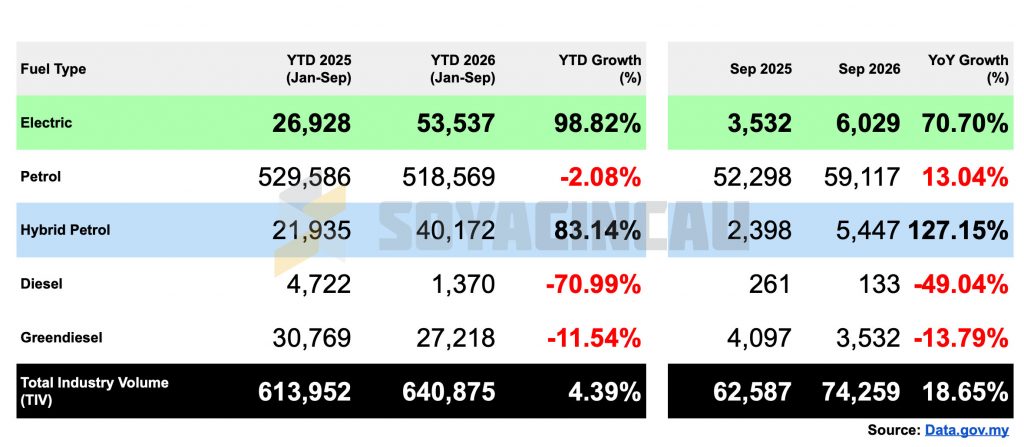
There are a total of 74,259 vehicles registered in September 2026, up 18.65% year-on-year from 62,587 units in September 2025.
EV registrations continue to grow, increasing 70.7% year-on-year from 3,532 units to 6,029 units.
Petrol vehicle registrations increased 13.04% year-on-year from 52,298 units to 59,117 units, while petrol hybrid registrations jumped 127.15% from 2,398 units to 5,447 units.
Diesel registrations continue to declined by 49.04% to 133 units, while Greendiesel registrations fell 13.79% to 3,532 units.
For Jan-Sep 2026, Malaysia recorded 640,875 total vehicle registrations, up 4.39% from 613,952 units during the same period last year.
EV registrations nearly doubled over the same period, rising 98.82% from 26,928 units to 53,537 units. Petrol hybrid registrations were also up 83.14%, while petrol registrations declined 2.08%.
Malaysia’s Top 30 EV Models in September 2026
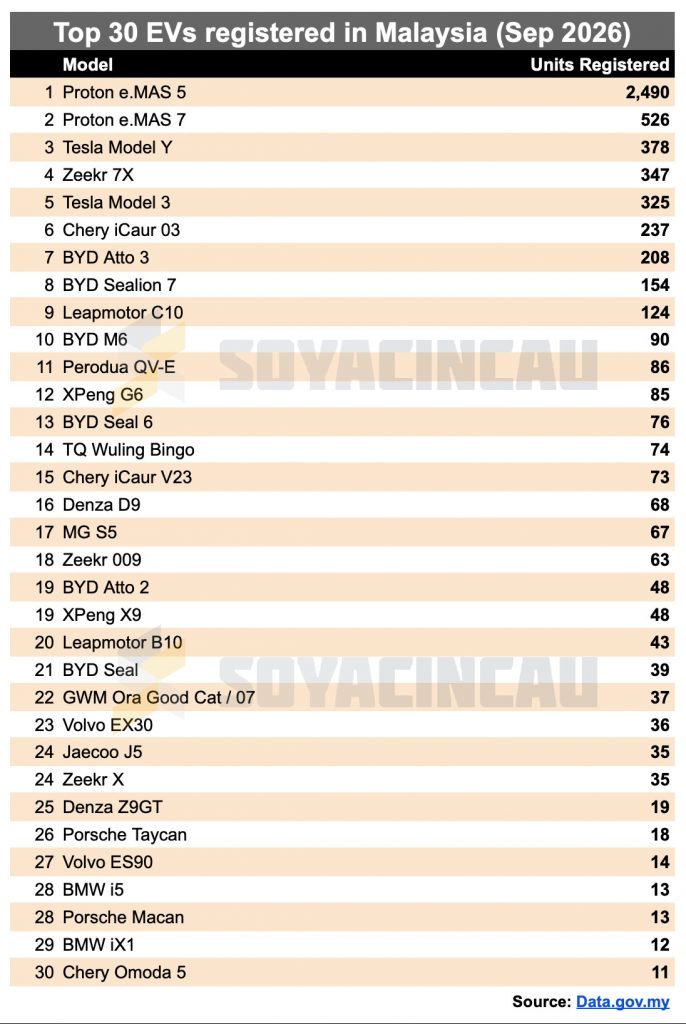
The Proton e.MAS 5 remained Malaysia’s most popular EV with 2,490 units in September despite its month-on-month decline from its record 4,770 registrations in August. This fully electric hatchback alone still accounted for 41.3% of all EVs registered during the month.
The Proton e.MAS 7 took second place with 526 registrations, followed by the Tesla Model Y in third with 378 units. Meanwhile, the Zeekr 7X is fourth with 347 units and Tesla Model 3 takes the fifth spot with 325 units.
The Chery iCaur 03 was sixth with 237 registrations, ahead of the BYD Atto 3 with 208 units. The BYD Sealion 7 took eighth place with 154 units, while the Leapmotor C10 was ninth with 124 registrations. Rounding out the Top 10 was the BYD M6 with 90 registrations.
The Perodua QV-E also rebounded to 86 registrations in September, up from 56 units in August. However, it remains below its current monthly high of 109 registrations recorded in July.
Further down the rankings, XPeng G6 recorded 85 units, TQ Wuling Bingo registered 74 units and Chery iCaur V23 recorded 73 units.
The Luxeed R7 (JV of Huawei and Chery under HIMA) has also made an appearance in last month’s registration with a total of 9 units registered.
Top 30 EV Models from January to September 2026
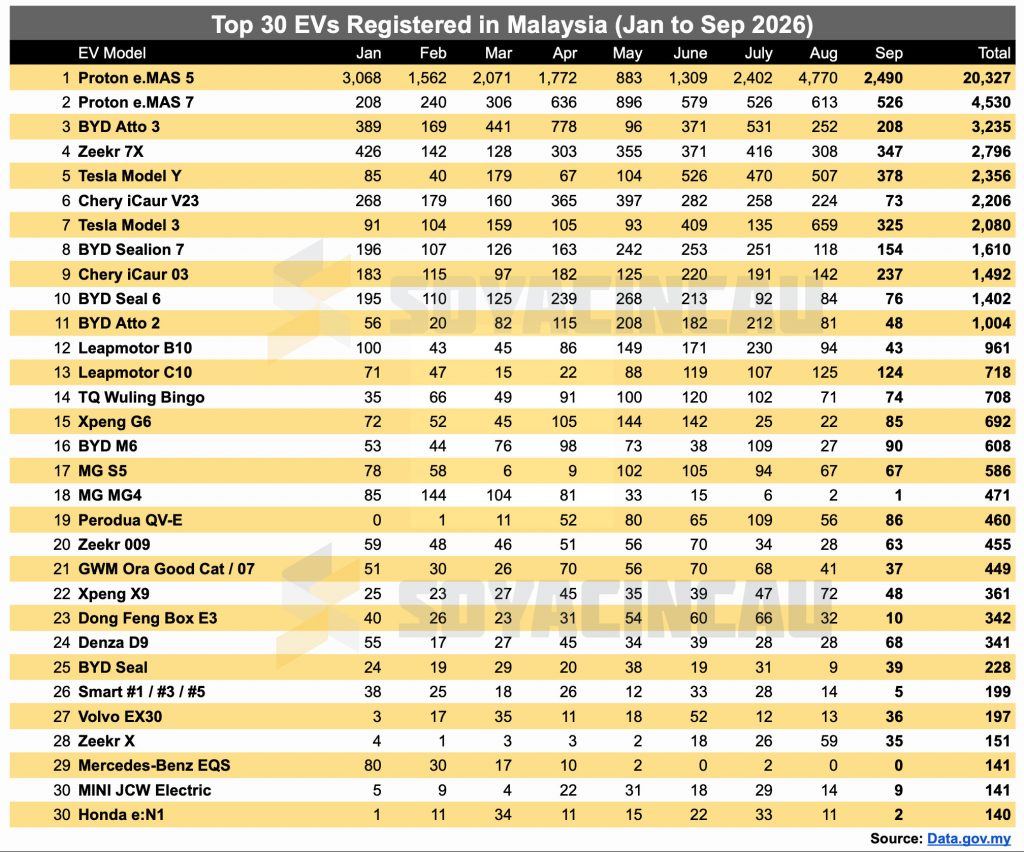
For the year to date, the Proton e.MAS 5 continues to hold a commanding lead with 20,327 registrations from January to September 2026.
The Proton e.MAS 7 is second with 4,530 registrations, followed by the BYD Atto 3 with 3,235 units.
The Zeekr 7X is fourth with 2,796 registrations, while the Tesla Model Y is fifth with 2,356 units. Following closely is the Chery iCaur V23 in sixth place with 2,206 units, followed by the Tesla Model 3 with 2,080 registrations and BYD Sealion 7 is eighth with 1,610 units.
The list continues with the Chery iCaur 03 with 1,492 units and BYD Seal 6 with 1,402 units.
Further down the table, Leapmotor B10 has accumulated 961 registrations, while Leapmotor C10 recorded 718 units. TQ Wuling Bingo is close behind with 708 units, followed by the XPeng G6 with 692 units.
Malaysia’s “home-grown” Perodua QV-E recorded 460 units from January to September 2026. Including registrations recorded in November and December 2025, a total of 498 QV-E units have been registered since launch.
Malaysia’s Top 20 EV Brands
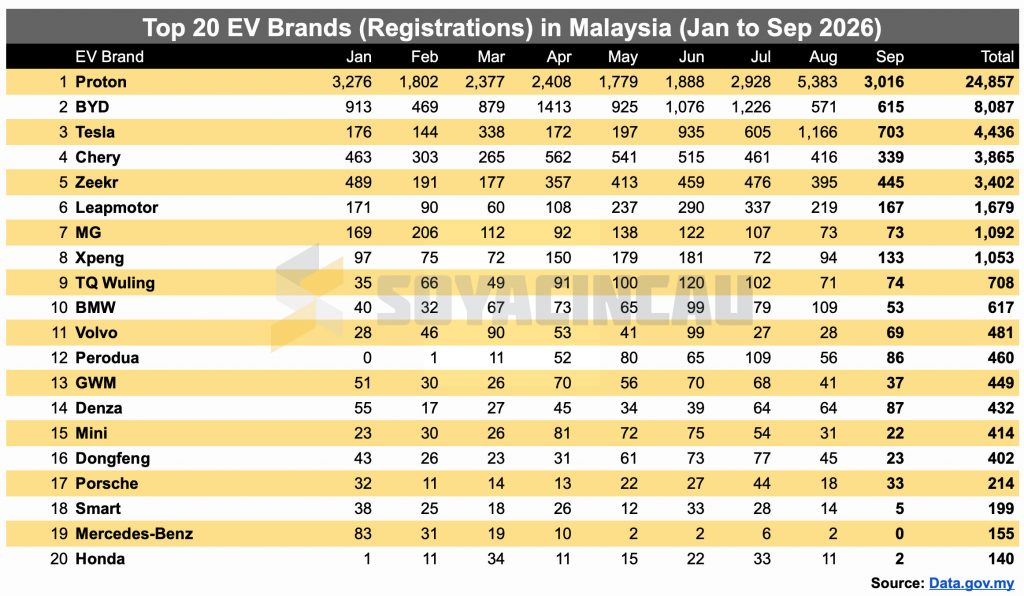
Proton e.MAS continues to dominate Malaysia’s EV market with 24,857 registrations from January to September 2026, representing 46.4% market share in the EV segment.
BYD remains the second-largest EV brand YTD with 8,087 registrations, followed by Tesla with 4,436 units.
Chery which is heavily driven by the iCaur sub-brand is fourth with 3,865 registrations YTD, while Zeekr is in fifth place with 3,402 units.
Leapmotor sits sixth with 1,679 registrations, followed by MG with 1,092 units and XPeng with 1,053 units.
TQ Wuling is ninth with 708 registrations, while BMW rounds out the Top 10 with 617 units.
EV charger deployment remains a concern
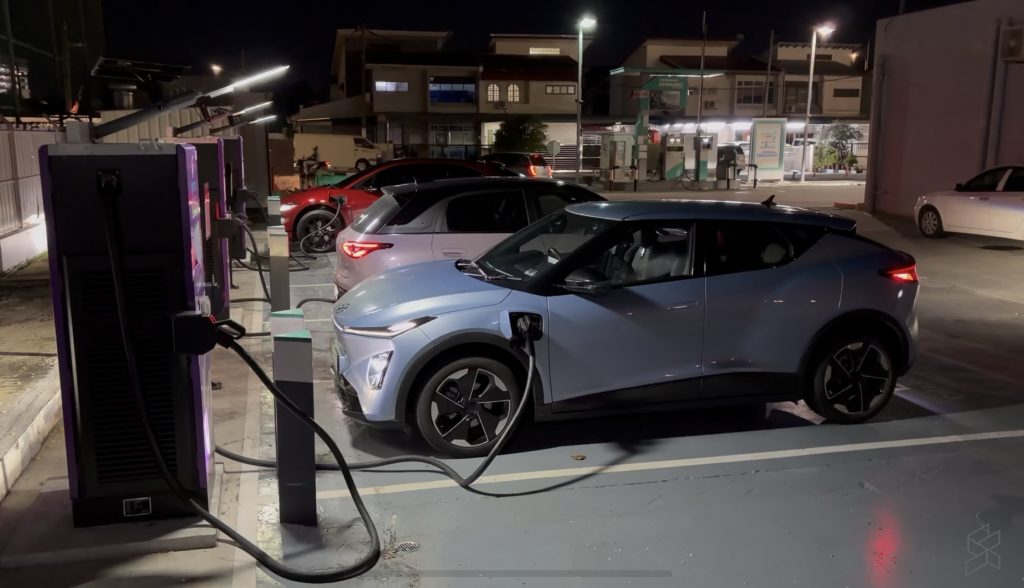
Malaysia’s EV adoption is accelerating faster than its charging infrastructure rollout. After failing to achieve 10,000 EV charge points by 2025 target, the government has revised its target to 30,000 EV charge points by 2030. As of July, the Energy Commission listed 6,178 licensed EV charge points in Peninsular Malaysia, which means deployment would need to accelerate significantly to meet the 2030 goal.
Highway charging remains especially important especially to support seamless EV journeys during the peak holiday season. During the tabling of Budget 2027, the Malaysian Highway Authority (LLM) is said to deploy 50 EV charging stations in 2027, while LLM is also targeting 500 highway charging points by 2030. There are currently 148 DC charging points on highways nationwide and some have been deployed and yet to turn on after two years.
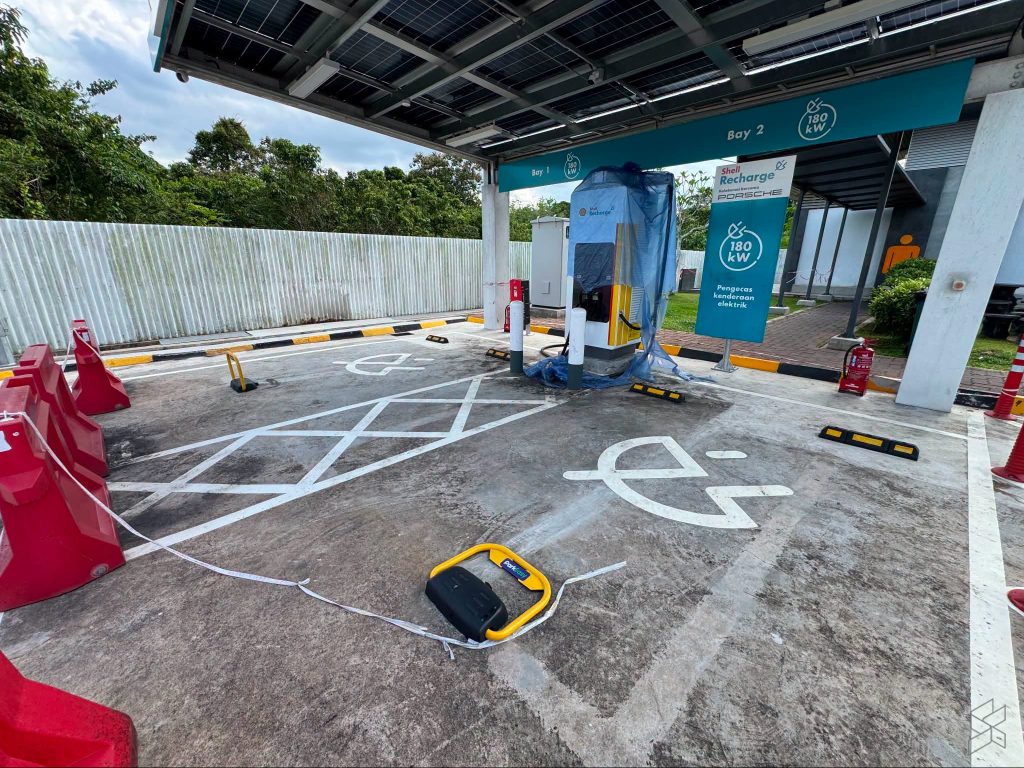
The concern is that EV charger deployment in Malaysia can still be slowed by land negotiations, lengthy approvals and electrical capacity upgrades. Some sites have taken close to a year from construction to activation, even before considering the time spent securing the site and approvals.
With EVs already accounting for 8.35% of Malaysia’s TIV from January to September 2026, the priority should be to create a proper green lane for EV charger approvals and grid upgrades so private investment can be deployed faster. Malaysia does not just need a higher charger target; the process to get chargers built and switched on needs to move much quicker.
Malaysia records 6,029 EV Registrations in September, making up 8.12% of TIV
News Reports PH


0 Comments