
Qualcomm is pushing things up a notch with the X2 Elite series, a year after it first entered the Windows PC space with the release of its Snapdragon X Elite.
With the new Snapdragon X2 Elite, the company is building on that foundation by upgrading the CPU, GPU, NPU and power architecture to deliver better sustained performance, expanded on-device AI capabilities and improved efficiency for next-generation laptops.
Ahead of its commercial release in the first half of 2026, Qualcomm had invited us to San Diego to take a closer look at the capabilities of the Snapdragon X2 Elite platform during a two-day Architecture Deep Dive.
While the results will ultimately depend on how OEMs implement their systems, Qualcomm’s own data shows meaningful architectural changes across the CPU, GPU, NPU and power-management stack.
3rd Gen Oryon CPU: Up to 18 cores and higher sustained performance
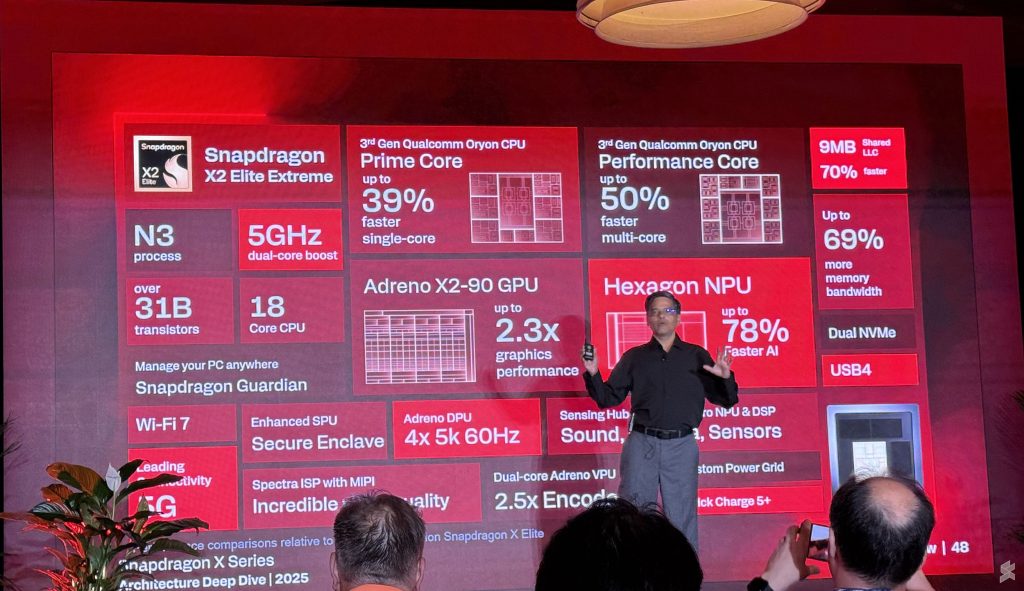
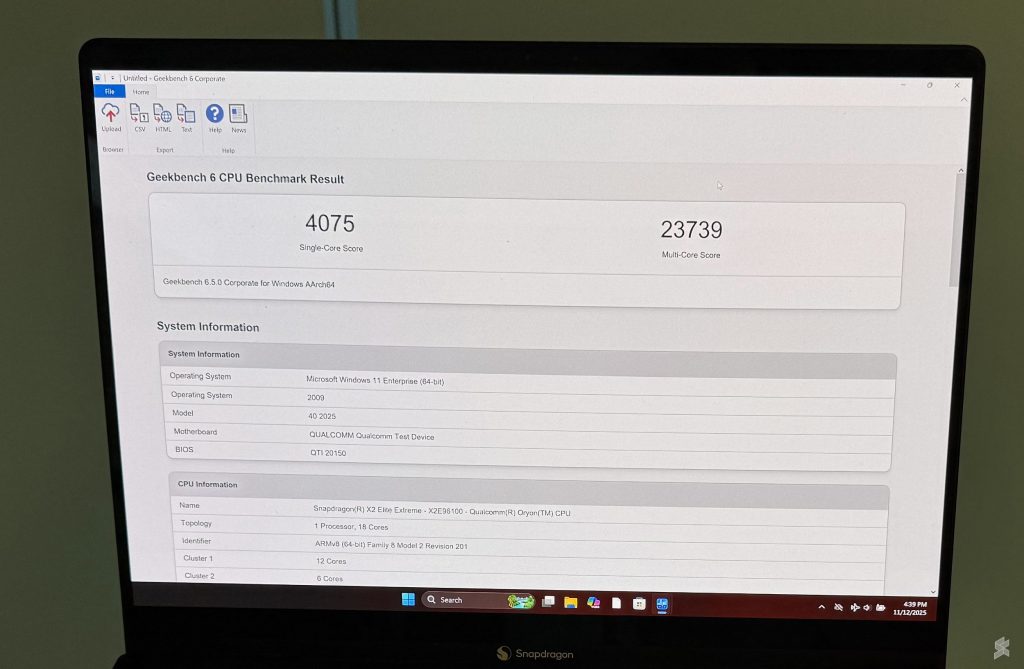
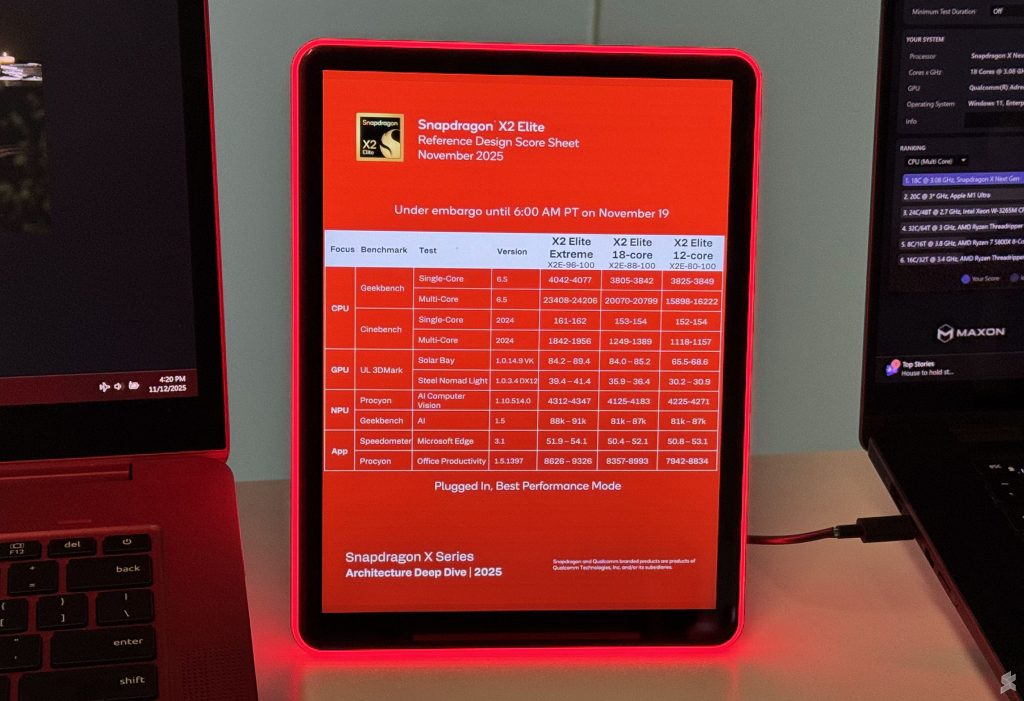
One of the key highlights is the updated 3rd generation Oryon CPU. Qualcomm revealed that Snapdragon X2 Elite will be available in configurations of up to 18 cores. The range topping X2 Elite Extreme (X2-96-100) had recorded a Geekbench 6.5 single-core score of 4,075 and a multi-core score of 23,739 based on their internal lab tests.
As a comparison, based on publicly available Geekbench 6 results, the 12-core Snapdragon X Elite typically scores around 2,400–2,500 in single-core and about 15,000 in multi-core.
Cinebench 2024 results reported by Qualcomm show the chip reaching up to 162 in single-core and up to 1,899 in multi-core workloads.
The new CPU also introduces a multi-level boost system, where a single core can reach up to 5.0GHz depending on workload, a design Qualcomm says helps maintain higher performance while managing thermals more intelligently.
Adreno GPU and Hexagon NPU upgrades: Improved performance and better efficiency
Graphics performance has also gotten a boost with Qualcomm’s updated Adreno GPU. According to Qualcomm, the new chip recorded up to 89.4 fps in 3DMark Solar Bay and up to 41.17 fps in Steel Nomad Light when tested on the reference design.
These gains come alongside architectural refinements that Qualcomm says contribute to better efficiency, particularly for sustained loads common in thin-and-light laptops.
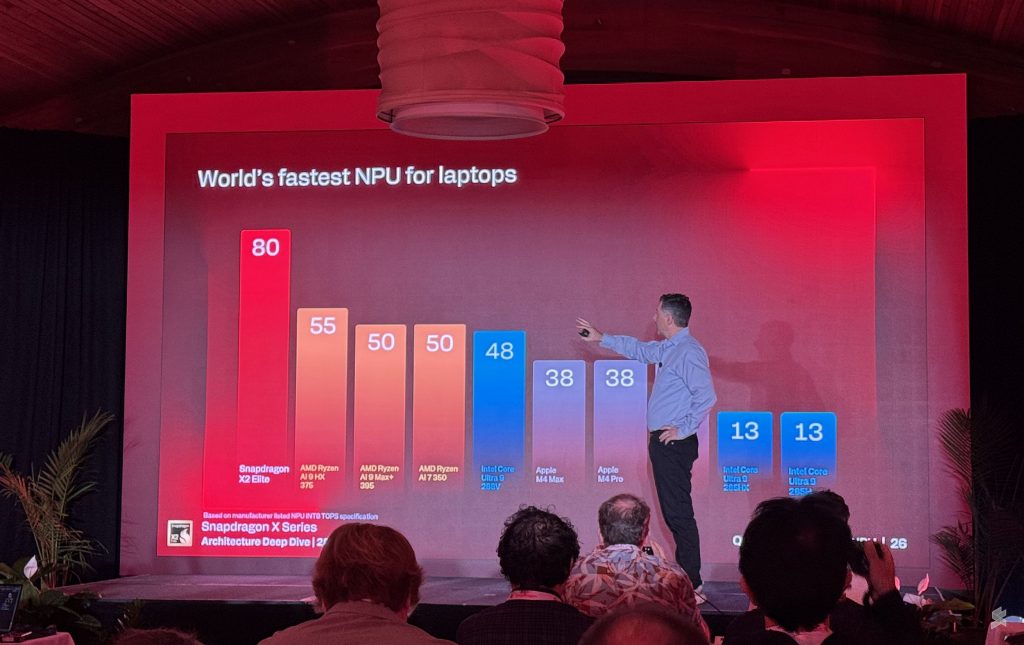
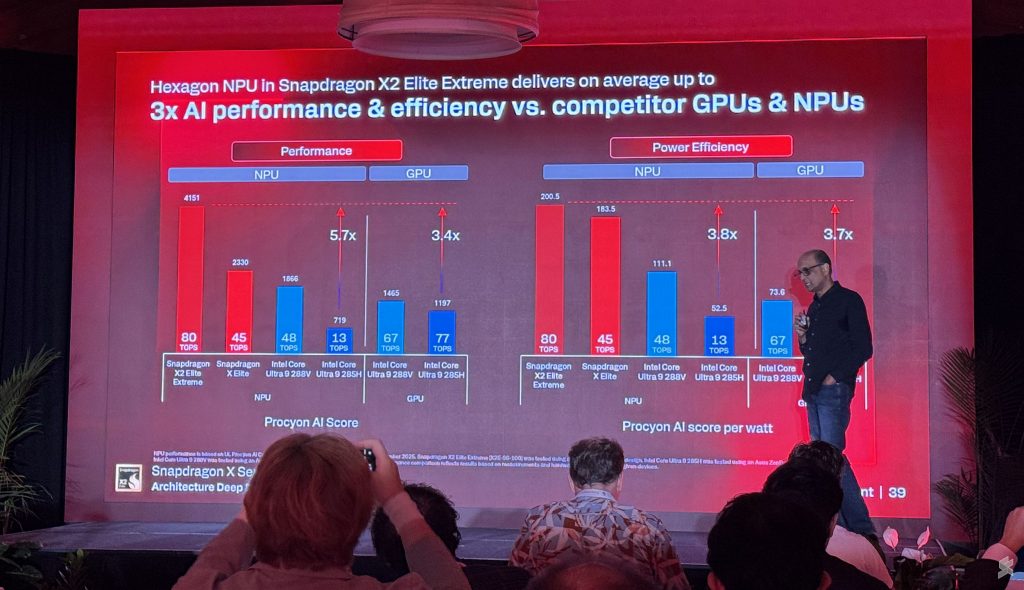
AI is a major focus for this generation. Qualcomm claims the new Hexagon NPU can deliver up to 80 TOPS of compute and significantly higher throughput across scalar, vector and matrix engines.
The company disclosed improvements of up to 143% in scalar throughput, 127% in bus bandwidth, 143% in vector throughput and 78% in matrix throughput compared to the previous generation.
Qualcomm’s AI team also shared that the platform now supports over 1,000 models, 300+ AI-powered user experiences and more than 100 optimised applications.
Qualcomm says these enhancements enable more sophisticated on-device AI use cases that don’t rely on the cloud.
Unplugged performance: High scores even on battery power
Qualcomm also puts a lot of emphasis on the X2 Elite’s unplugged performance. In its internal tests, the company was able to demonstrate that Snapdragon X2 Elite is able to maintain similar performance on battery across multiple benchmarks, including Geekbench, Cinebench, Speedometer, Procyon Office, Procyon AI and 3DMark Solar Bay. Most tests report performance retention close to 100%, and the lowest recorded was 85.6% for Speedometer 3.1.
Qualcomm states that the benchmarks reflect the X2 Series’ ability to deliver “great performance on battery” with minimal drop when switching from AC to DC modes.
Battery efficiency is another area where Qualcomm claims improvements. According to the power and thermals briefing, the Snapdragon X2 Series achieves more than 10% chipset power reduction across day-to-day scenarios such as web browsing, office productivity, YouTube streaming and Teams calls. Qualcomm adds that idle and local video playback power consumption is targeted to be on par with the previous generation.
In a nutshell, Qualcomm highlighted that these improvements significantly increase performance while maintaining great battery life. After all, the goal is to provide road warriors all day performance without lugging a power adapter.
Productivity benchmarks shared by Qualcomm also show improvements. Speedometer 3.1 recorded up to 53.1, while Procyon Office reached up to 8,990 on the reference system.
Obviously these tests were performed on Qualcomm’s own hardware under controlled conditions. It would be interesting to see how these new chips fare on OEM hardware.
Scalability across laptop designs and form factors
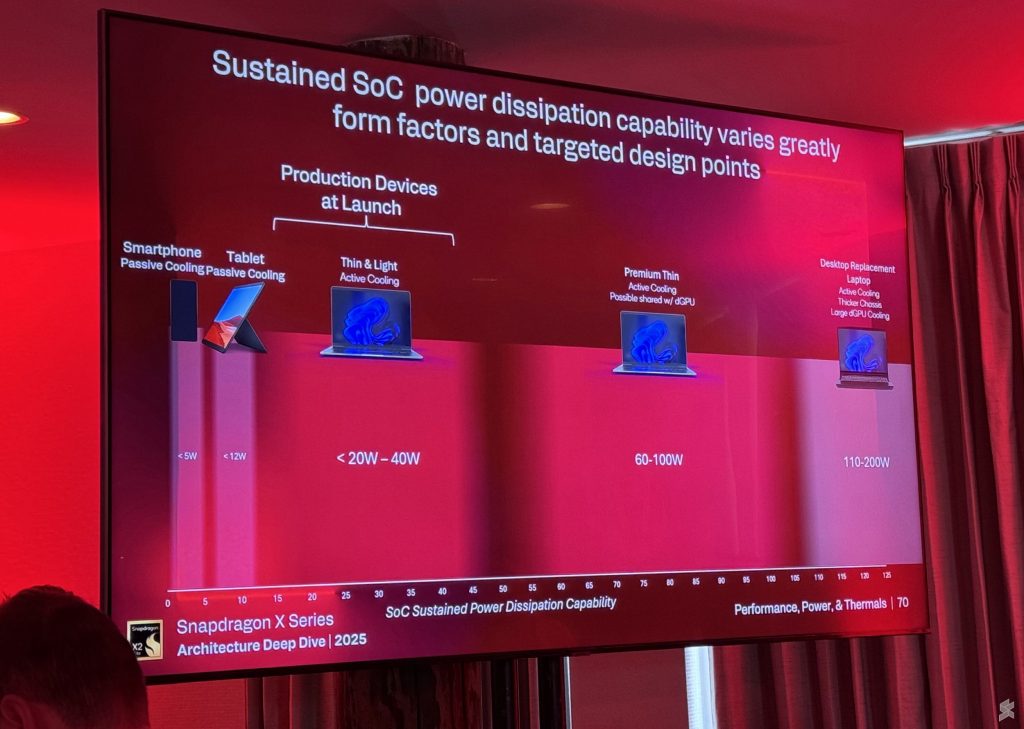
Qualcomm also outlined how the X2 Elite scales across different laptop form factors. The company’s sustained power dissipation charts show the platform operating within <20W–40W envelopes for thin-and-light laptops. There are also higher ranges reserved for thicker devices with active cooling.
Qualcomm says the flexibility allows OEMs to tune their devices for a variety of thermal and performance targets, which is critical for reaching the wide PC form factors addressed by the Snapdragon X Series.
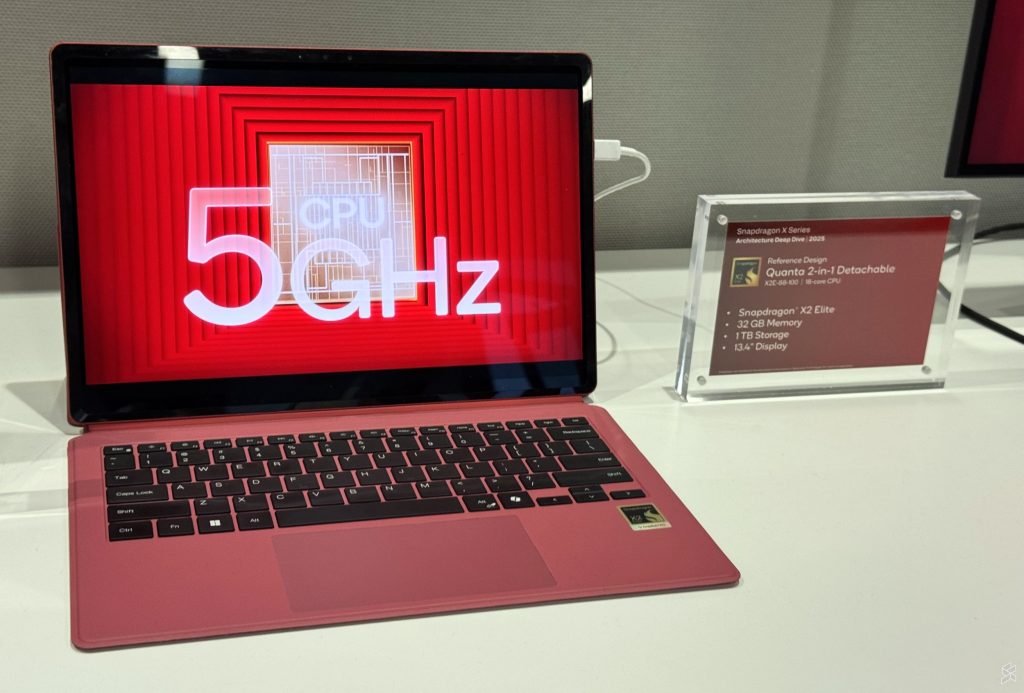
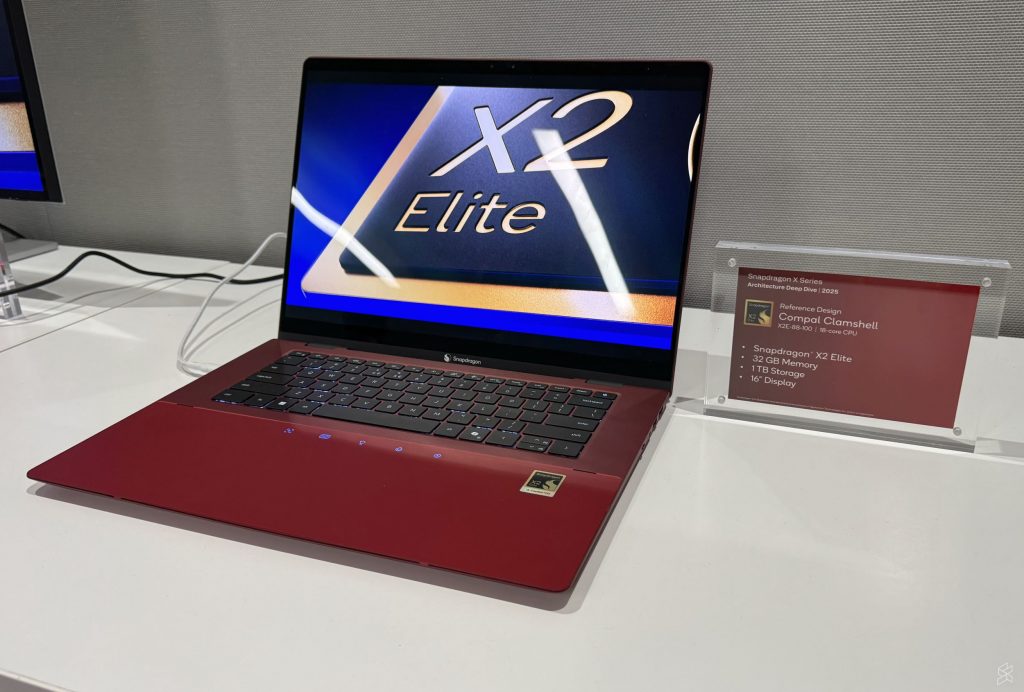
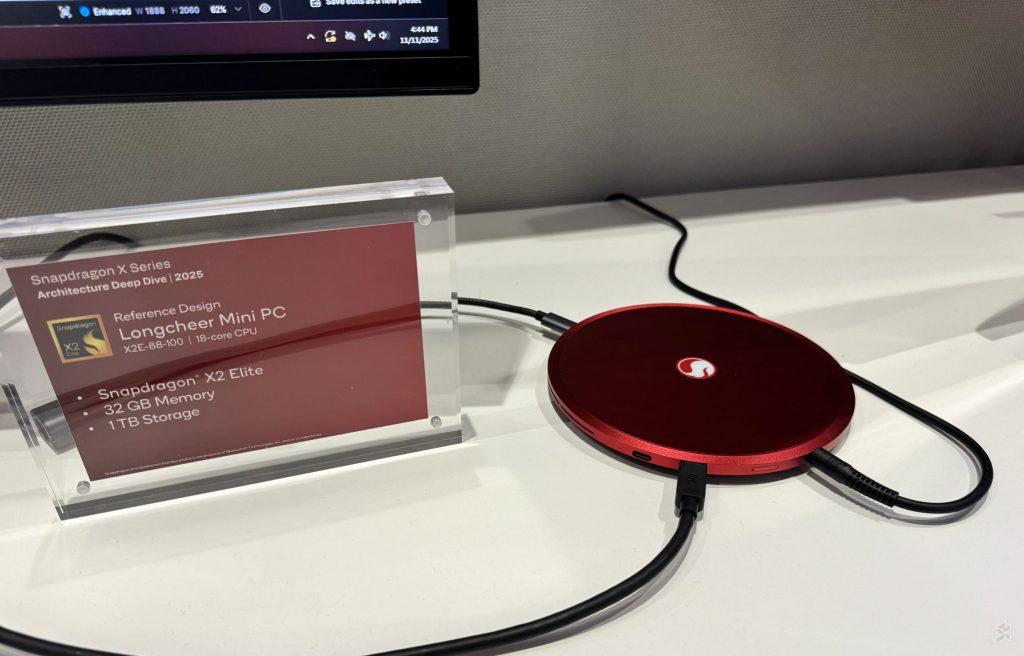
From Qualcomm’s perspective, the Snapdragon X2 Elite introduces platform-wide updates that improve compute performance, graphics capability, AI acceleration, thermal management and power efficiency. The company’s own numbers paint the X2 Elite as a meaningful step forward for battery-mode performance and on-device AI workloads, though the final user experience will depend heavily on the laptops that ship with this chip.
Snapdragon X2 Elite Deep Dive: Qualcomm’s biggest leap yet for Windows laptops
News Reports PH


0 Comments