
If you feel that Malaysia’s 5G is not as fast as before, you’re not alone.
Just a few years ago, Malaysia not only had one of the fastest 5G rollouts in the world, but was regularly ranked highly among the fastest and most consistent globally. Today, the experience looks noticeably different.
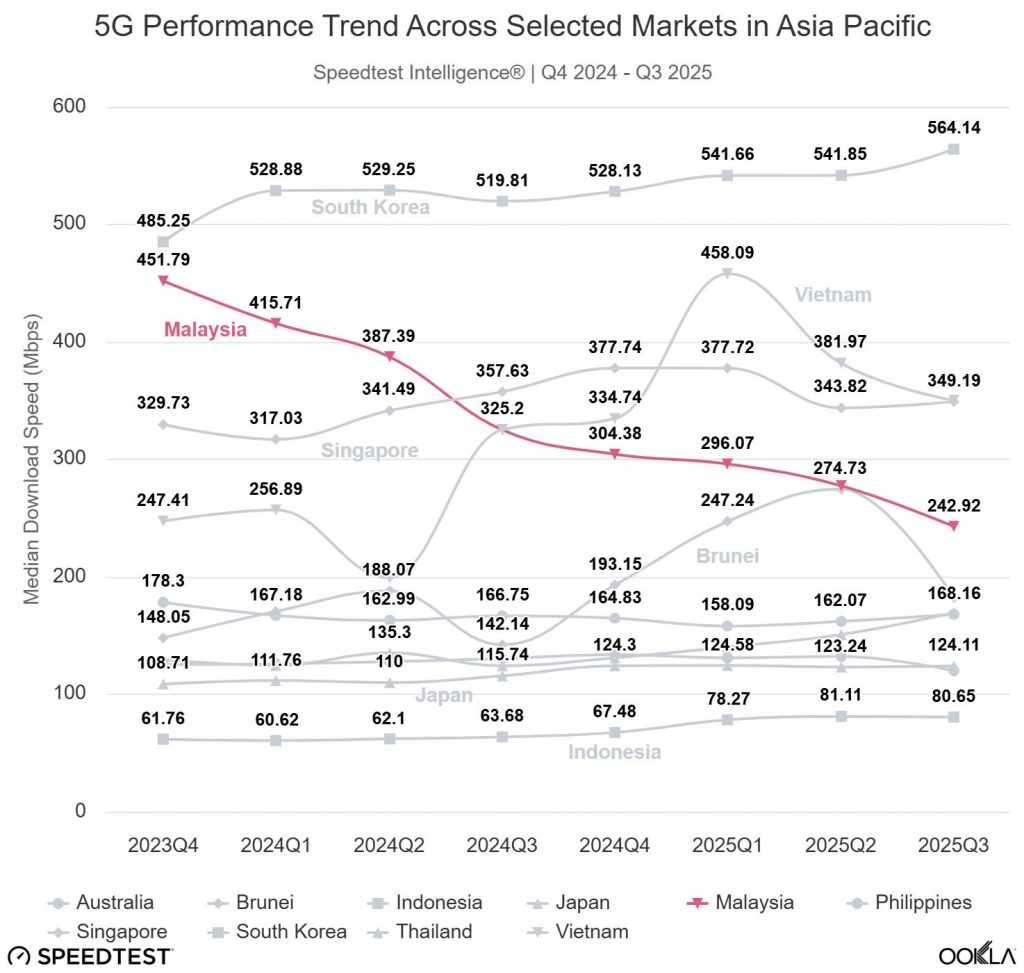
Malaysia’s median 5G download speed dropped from 452Mbps to 243Mbps
According to Ookla’s recent report, Malaysia’s median 5G download speed has dropped by 46%, from 451.79 Mbps in Q4 2023 to 242.92 Mbps in Q3 2025.
Similarly, the median 5G upload speed has also declined by 41% from 49.87Mbps in Q4 2023 to 29.52Mbps in Q3 2025.
Meanwhile, for median 5G latency, we are seeing a slight increase from 16ms in Q4 2023 to 19ms in Q3 2025.
When compared to other peers in region, Malaysia’s 5G download and upload speeds are still higher than Australia, Indonesia, Japan, the Philippines and Thailand. However, we have been outperformed by Singapore, South Korea and Vietnam.

However, these figures only tell part of the story and we need to look at the current 5G situation in Malaysia including policy, subscribers, 5G adoption and also spectrum.
The biggest change took place early this year when Malaysia officially revoked Digital Nasional Berhad’s status as a Single Wholesale Network. This comes after MCMC appointed U Mobile as the telco to deploy the country’s second 5G network.
MCMC: Malaysia’s 5G performance in line with JENDELA aspirations
The Malaysian Communications and Multimedia Commission (MCMC) noted the report by Ookla which has provided an independent snapshot of the current mobile experience in the region. In its response, it highlighted that Malaysia’s 5G rollout has achieved 82.4% population coverage, with 5G penetration at 84%.
The regulator shared that Malaysia’s 5G subscriptions has increased six-fold within two years from 4.6 million in November 2023 to 17.7 million in November 2024, and with further increase to 28.7 million by November 2025.
Based on internal data obtained via MCMC Nexus, the regulator said Malaysia’s average 5G download speeds remain robust with over 218Mbps download and 34Mbps upload on DNB’s network.
Meanwhile, U Mobile’s ULTRA5G network delivers over 315Mbps download and 50Mbps upload. These performance levels, according to MCMC, are in line with the aspirations outlined under JENDELA which has a 5G network design target of 100Mbps at the cell edge.
DNB carries most of Malaysia’s 5G traffic with half its original spectrum
When DNB was established in 2021 as the nation’s Single Wholesale Network, it was allocated three spectrum bands:
- 2x 20MHz (40Hz) block of 700MHz (703-723 MHz and 758-778 MHz)
- 2x 100MHz (200MHz) blocks of 3.5GHz (3.4GHz to 3.6GHz)
- 1600MHz block of 26/28GHz mmWave
Among the three spectrum bands, 3.5GHz is the most crucial as it offers the perfect balance between coverage, speed and capacity. As a Single Wholesale Network, 200MHz would have been more than sufficient to carry the entire nation’s 5G traffic.
When Malaysia decided to adopt a dual 5G network model, DNB had to give up half (100MHz) of its 3.5GHz spectrum. Under the Ministerial Direction No. 1 of 2024 issued by Communications Minister Datuk Fahmi Fadzil on 21st June 2024, the government reassigned DNB’s 3.5GHz to 3.6GHz block for the second 5G network.
Eventually, U Mobile was appointed as the telco to roll out the second 5G network. The orange telco launched its own 5G service under the ULTRA5G branding, with the aim to achieve 80% 5G population coverage by the second half of 2026.
With the 5G policy change, DNB was left with 100MHz on 3.5GHz to support customers from CelcomDigi, Maxis, Unifi Mobile and Yes 5G, while the remaining 100MHz was assigned for U Mobile to build a brand new 5G network.
It is worth pointing out that back in December 2022, DNB warned that splitting the 3.5GHz spectrum would cause inefficient use of the spectrum. It claimed that peak 5G speeds would drop by 50% and DNB would need to build additional 8,000 sites to provide the same coverage and committed quality of services.
The extra 8,000 sites would require an additional RM5.4 billion in incremental funding.
DNB gets back additional 100MHz but it will take time
Before MoF Inc exits from DNB, the government has finally taken steps to address the current network constraints faced by DNB.
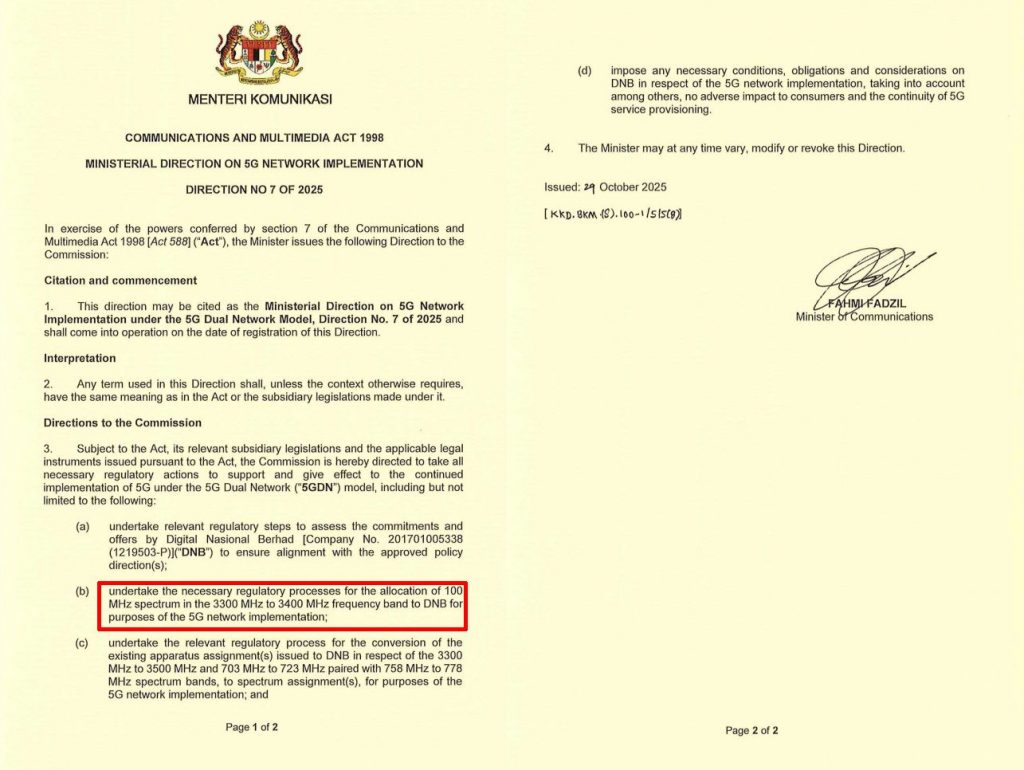
On 29th October 2025, the Communications Minister issued a Ministerial Direction No. 7 of 2025, to allocate additional 100MHz spectrum (3.3GHz to 3.4GHz) to DNB for its 5G network implementation.
In an interview with The Edge, DNB CEO Datuk Azman Ismail thanked the government for providing additional spectrum to sweeten the deal for the remaining three shareholding telcos in the network.
He said, “Certain spectrum was taken away from us, but now, it is being reassigned to DNB.”
DNB CTO Ken Tan revealed that 84.2% of 5G traffic from close to 29 million users runs through DNB’s network. He added that the additional 100MHz spectrum is significant for user experience especially for 5G enterprise solutions, as the loss of the 100MHz spectrum had affected 5G network quality.
However, it is worth noting that the recently assigned 100MHz block is different and it will take time and resources to reconfigure and optimise the network. DNB expects to officially receive the 100MHz spectrum assignment by the first quarter of 2026.
It is also worth noting that the government has also converted the allocation of existing spectrum from apparatus assignment (AA) to spectrum assignment (SA), which provides DNB long term certainty. Typically AA are short term with annual renewals while SA typically last 10 to 15 years long according to DNB COO Datuk Ahmad Zaki.
Why have Malaysia’s 5G download speeds declined?
News Reports PH


0 Comments