
Malaysia’s electric vehicle (EV) adoption continues to accelerate in 2026, supported by a wider range of models and increasing consumer interest due to the ongoing Middle East crisis.
According to the latest JPJ vehicle registration data, a total of 5,894 EVs were registered in April 2026, representing a 103.8% increase year-on-year compared to 2,892 units recorded in April 2025.
This strong performance comes alongside signs of recovery in the overall car market. Total Industry Volume (TIV) for April 2026 stood at 77,819 units, up 19.4% year-on-year from 65,200 units last year.
EVs now account for approximately 7.6% of total registrations in April, which is about 1 in 13 new vehicles registered in Malaysia.
EV registrations exceed 20,000 units in first four months of 2026
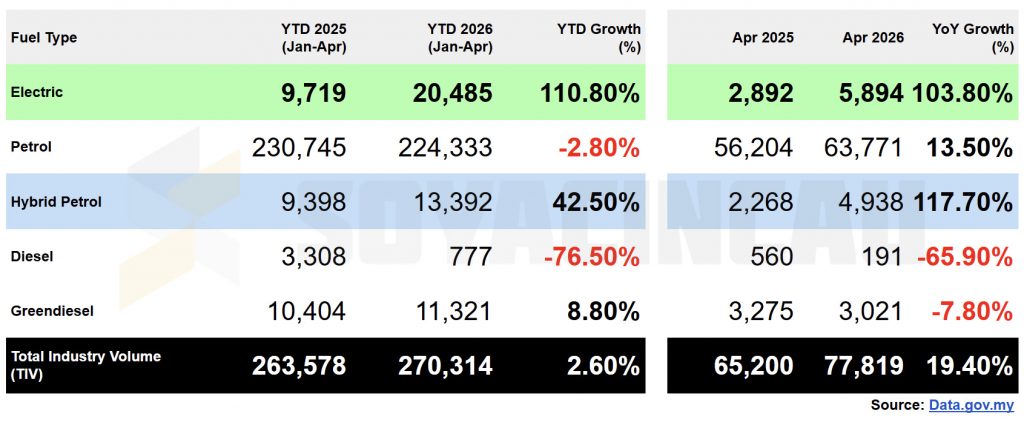
Looking at the bigger picture, Malaysia’s EV market has already surpassed a major milestone. For the first four months of 2026, total EV registrations reached 20,485 units, marking a 110.8% increase year-on-year compared to 9,719 units recorded in the same period last year.
While the overall car market remains relatively flat with TIV growing just 2.6% year-on-year, EVs continue to significantly outperform all other fuel types.
Interestingly, Hybrid (petrol) vehicles saw strong growth with 13,392 units registered year-to-date, up 42.5% year-on-year, while April alone recorded a sharp 117.7% increase compared to the same month last year. The growth in Hybrid was led by Proton e.MAS 7 PHEV with 1,013 units, followed by the Toyota Vios Hybrid with 643 units and Toyota Corolla Cross Hybrid with 580 units.
Petrol vehicles, which still dominate overall volume, recorded a 2.8% decline year-to-date, although April itself shows growth of 13.5% year-on-year.
Diesel registrations, however, continue to decline, showing a plunge of 76.5% year-to-date. Meanwhile, April Diesel registrations are down 65.9% year-on-year. Meanwhile, green diesel recorded modest growth of 8.80% year-to-date but declined slightly by 7.80% in April.
Proton e.MAS 5 continues to dominate EV market
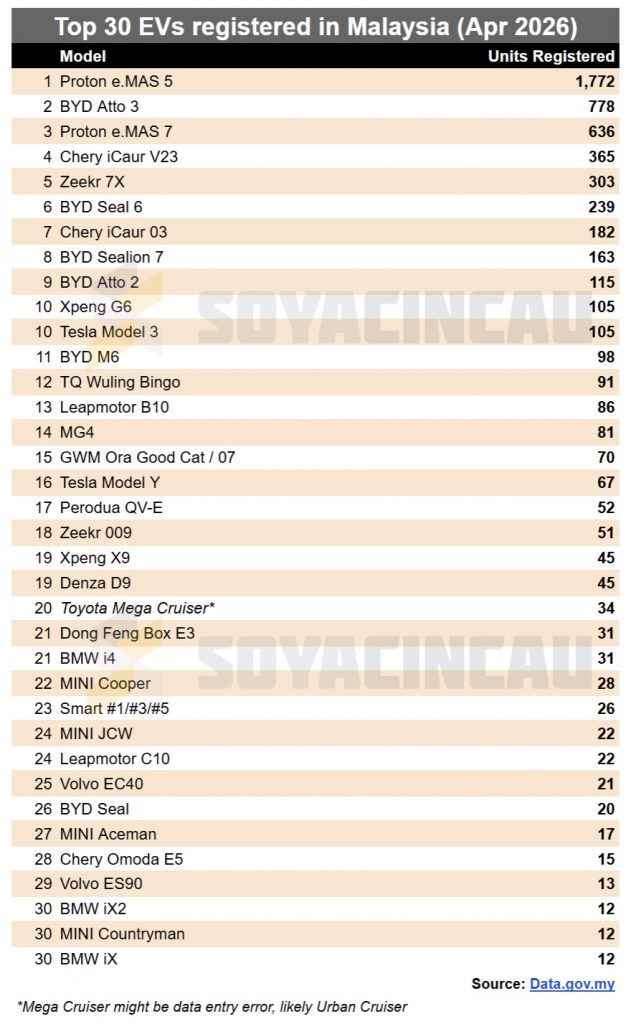
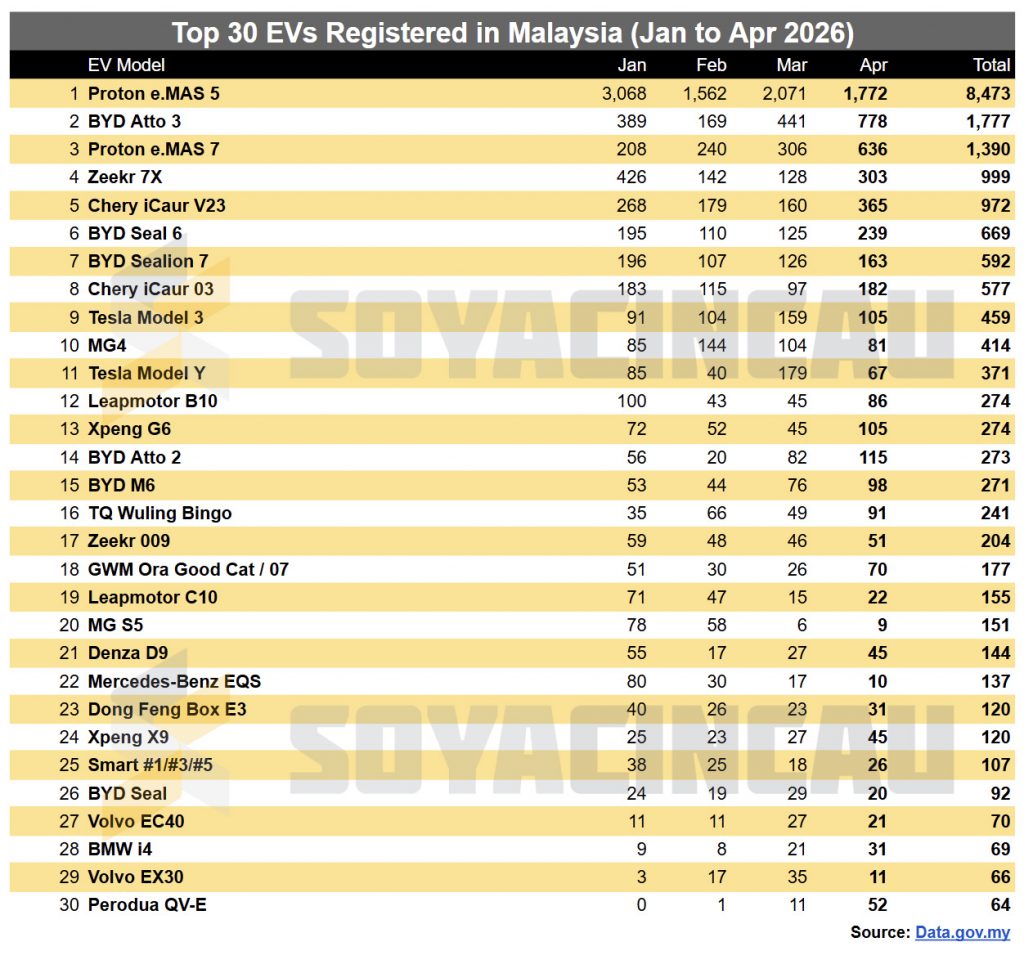
Looking at the Top 30 list for April, the Proton e.MAS 5 continues to lead the market by a significant margin with 1,772 units registered in April, bringing its year-to-date total to 8,473 units.
This is followed by the BYD Atto 3 at #2 with 778 units in April (1,777 units YTD), and the Proton e.MAS 7 at #3, which recorded 636 units in April (1,390 units YTD).
The list continues with Chery iCaur V23 at #4 with 365 units (972 units YTD) and Zeekr 7X at #5 with 303 units (999 units YTD).
It is also worth highlighting that the Perodua QV-E finally made it to the Top 20 list at #17 with a total of 52 units registered. This is a new monthly record high for Perodua and there are now 102 QV-Es registered since its launch last year.
There’s also an abnormally with April’s data where the Toyota Mega Cruiser at #20 recorded 34 units. The Mega Cruiser is essentially Japan’s answer to the Humvee that’s powered by a turbo diesel engine. This should be a data entry error and the record is likely to be a Toyota Urban Cruiser or the BZ4X which was launched last month.
Proton e.MAS dominates EV segment, followed by BYD
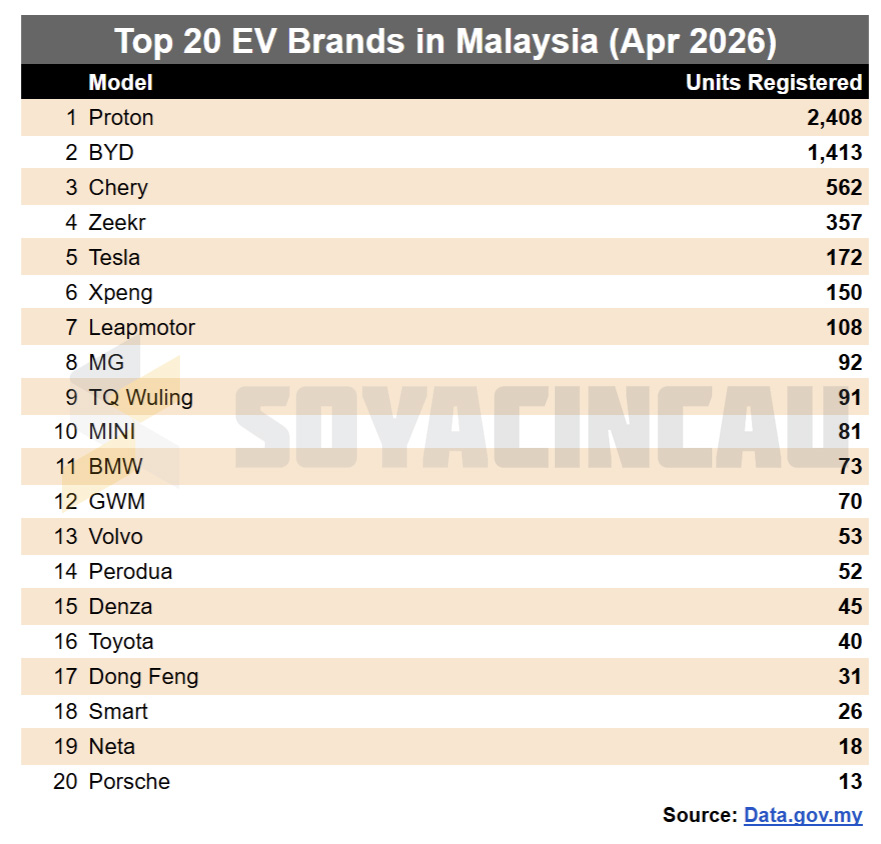
When it comes to the brand level, Proton continues to lead the EV market by a wide margin. The full e.MAS EV lineup recorded 2,408 EV registrations in April, followed by BYD at #2 with 1,412 units and Chery at #3 with 562 units.
The list continues with Zeekr at #4 with 357 units and Tesla at #5 with 172 units.
EV registrations have not only sustained their momentum but continue to grow at a rapid pace, driven by more affordable options such as the Proton e.MAS 5, as well as ongoing deals and promotions across the market.
At the same time, rising fuel prices and adjustments to current subsidy policies including the temporary reduction of the RON95 quota to 200L are likely pushing more consumers to consider EVs and PHEVs as viable alternatives.
Slower EV growth with MITI’s latest CBU EV rules?
With MITI’s new CBU EV rules which raises the floor price to over RM300,000 for imported EVs, there is growing concern that the move could slow EV adoption at a time when Malaysia’s fuel subsidy bill has risen to as high as RM7 billion in a single month.
The latest policy effectively wipes out a large portion of popular EV options in the market, including the entire BYD EV lineup (BYD Atto 2, Atto 3, Seal 6, M6, Sealion 07, etc). While MITI says claims that EVs will become more expensive are inaccurate, the key question remains: can local CKD production capacity keep up with demand?
Based on current growth trends and the expected push for EVs driven by the fuel situation, Malaysia’s EV registrations could reach 80,000 units this year. Proton’s EV plant in Tanjung Malim has a rated annual capacity of 20,000 units, while other CKD EV players are either still planning or in the midst of ramping up production.
BYD had initially announced plans for CKD production in Tanjung Malim. However, these plans were reportedly stalled due to disagreements with MITI’s conditions. These include a minimum on-the-road (OTR) price of RM100,000, as well as a requirement to export 80% of production, with only 20% allocated for the domestic market.
Malaysia EV registrations more than double in April 2026, over 20,000 registered in four months
News Reports PH


0 Comments