
Malaysia recorded 6,937 EV registrations in July 2026, according to the latest vehicle registration data from JPJ. This represents a massive 148.5% increase year-on-year from 2,792 EVs registered in July 2025.
EVs accounted for 8.67% of Malaysia’s 80,030 total vehicle registrations for the month.
For the first seven months of 2026, Malaysia recorded 38,675 EV registrations. This represents a growth of 94.0% from 19,935 units during the same period last year.
EV growth continues to outpace Malaysia’s overall automotive market
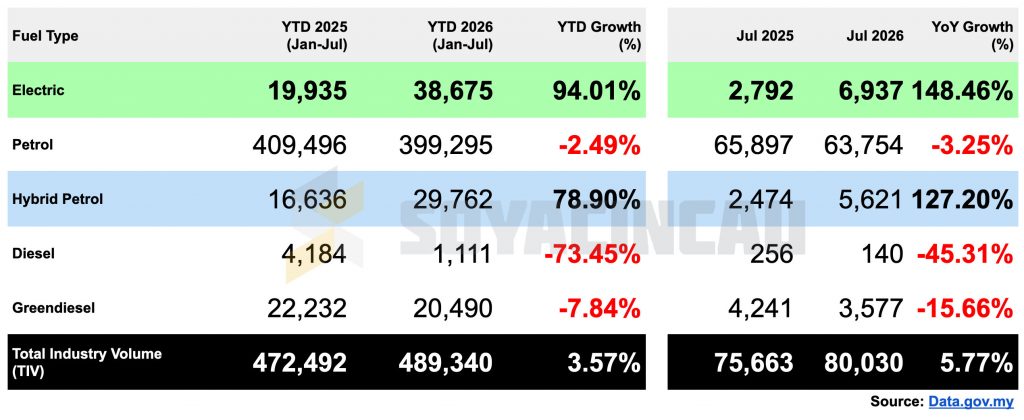
Malaysia recorded a total of 80,030 new vehicle registrations in July 2026, up 5.77% from 75,663 units in July 2025. As shown above, EVs show the highest growth among all fuel types.
Petrol remained the dominant fuel type with 63,754 registrations, down 3.25% year-on-year. Meanwhile, petrol hybrid registrations continued to grow significantly with 5,621 units, up 127.20% from 2,474 units in July last year.
Diesel registrations declined 45.31% year-on-year to 140 units, while Green Diesel registrations fell 15.66% to 3,577 units.
For the first seven months of 2026, Malaysia recorded 489,340 vehicle registrations, up 3.57% from 472,492 units during the same period last year.
EVs accounted for 7.90% of total registrations YTD, almost double the 4.22% share recorded during the same period in 2025.
Proton e.MAS 5 dominates July 2026 EV registrations
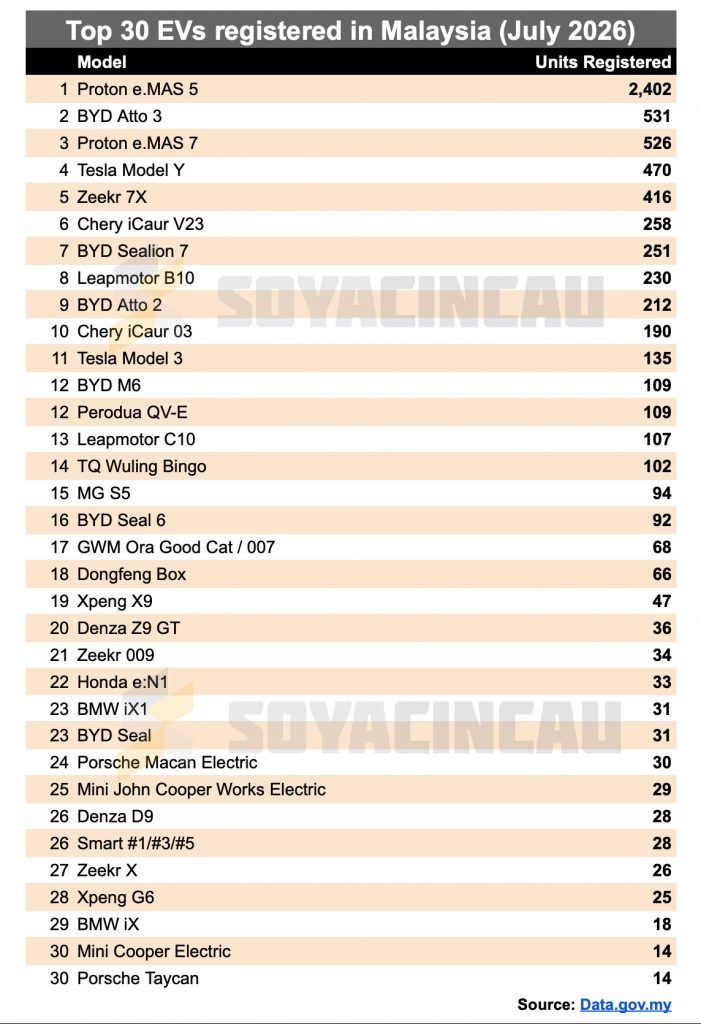
The Proton e.MAS 5 continues to dominate Malaysia’s EV market with a record 2,402 registrations in July, a significant jump from 1,309 units in June.
The BYD Atto 3 took second place with 531 registrations, which is slightly ahead of the Proton e.MAS 7 with 526 units.
Tesla’s rebound continued in July, although at a slower pace. The Tesla Model Y was Malaysia’s fourth most registered EV with 470 units, down slightly from 526 units in June. Meanwhile, the Tesla Model 3 fell from 409 units in June to 135 units in July.
Rounding out the top five was the Zeekr 7X with 416 registrations, up from 371 units in June.
The Chery iCaur V23 was sixth with 258 registrations, followed by the BYD Sealion 7 with 251 units, Leapmotor B10 with 230 units, BYD Atto 2 with 212 units and Chery iCaur 03 with 190 units.
The Perodua QV-E also recorded its best month so far with 109 registrations in July, up from 65 units in June and 80 units in May.
In total, there are now 356 QV-E EVs registered since launch.
Proton e.MAS 5 exceeds 13,000 registrations in 2026
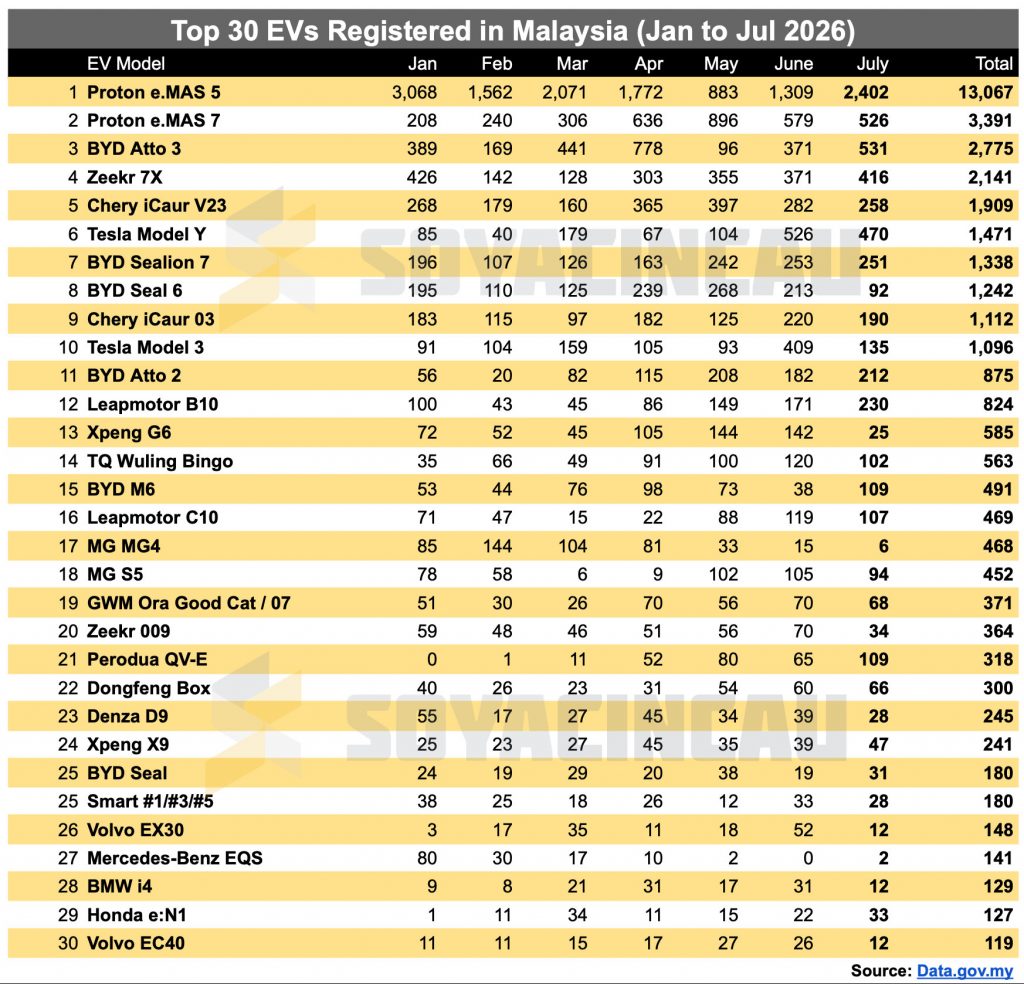
For the first seven months of 2026, the Proton e.MAS 5 remains Malaysia’s #1 EV by a huge margin, with 13,067 registrations.
The Proton e.MAS 7 takes second place with 3,391 units, followed by the BYD Atto 3 at #3 with 2,775 units.
The Zeekr 7X ranks fourth with 2,141 registrations, while the Chery iCaur V23 rounds out the top five with 1,909 units.
The e.MAS 5 alone accounted for almost 35% of all EVs registered in Malaysia in July, while Proton’s two e.MAS models collectively recorded 2,928 units during the month.
Proton leads Malaysia’s EV brands, Tesla narrowly ahead of Zeekr YTD
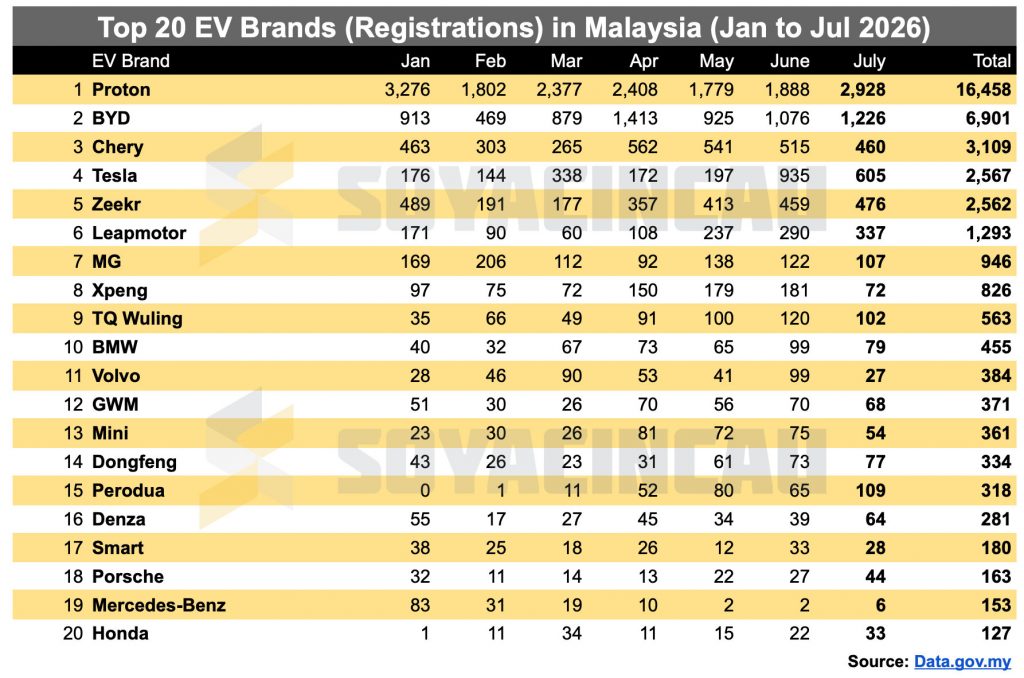
When we look at the brand level, Proton recorded 2,928 EVs in July, representing more than 42% of all EV registrations for the month. BYD took second place with 1,226 units, followed by Tesla at #3 with 605 units, Zeekr at #4 with 476 units and Chery at #5 with 460 units.
For January to July 2026, Proton leads with 16,458 EV registrations, followed by BYD with 6,901 units and Chery with 3,109 units.
Tesla is at #4 with 2,567 units YTD, followed closely with Zeekr at #5 with 2,562 units.
Malaysia is on track for another record EV year, but chargers need to catch up
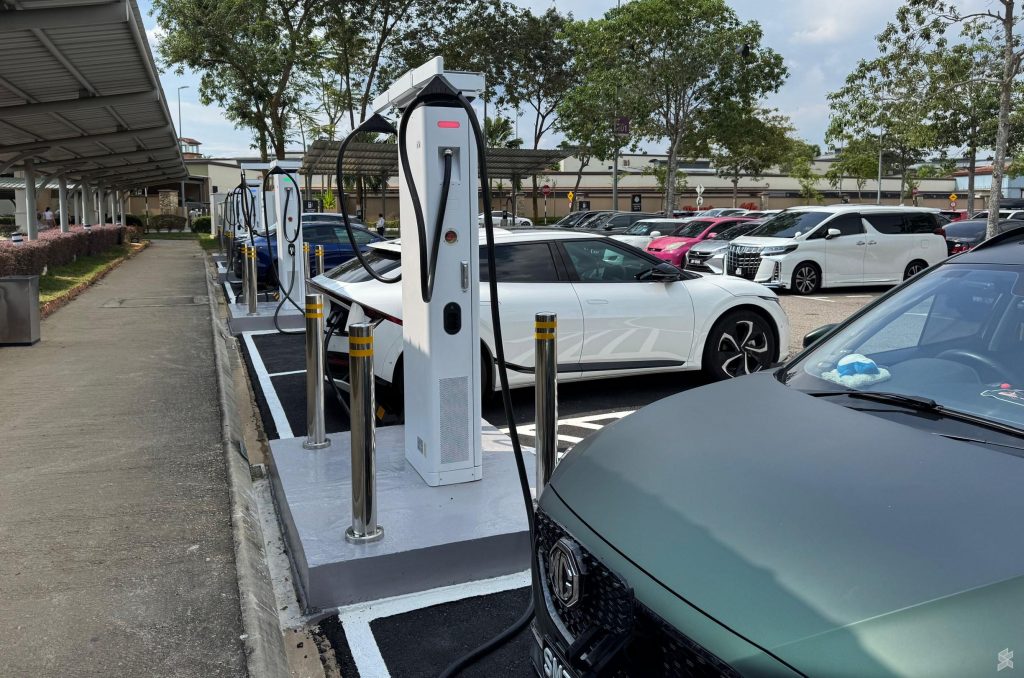
With 38,675 EVs registered from January to July 2026, Malaysia is only 6,138 units away from matching the 44,813 EVs registered throughout 2025. At the current pace, last year’s record could be surpassed as early as August.
However, EV charging infrastructure needs to catch up quickly with the growing number of EVs on the road, especially along highways where chargers will face greater pressure during festive and peak travel periods. While the government is considering an EV levy to fund more chargers, the bigger problem remains slow approvals, insufficient grid capacity and the lack of a streamlined process to get chargers turned on quickly.
As we’ve highlighted previously, some high-powered DC chargers have been installed but remained not turned on for over a year. With EV registrations up 94% YTD, the priority should be removing these deployment bottlenecks and getting new charging capacity online faster.
Malaysia EV registrations surge 148% in July 2026, Proton e.MAS 5 remains #1 EV
News Reports PH


0 Comments